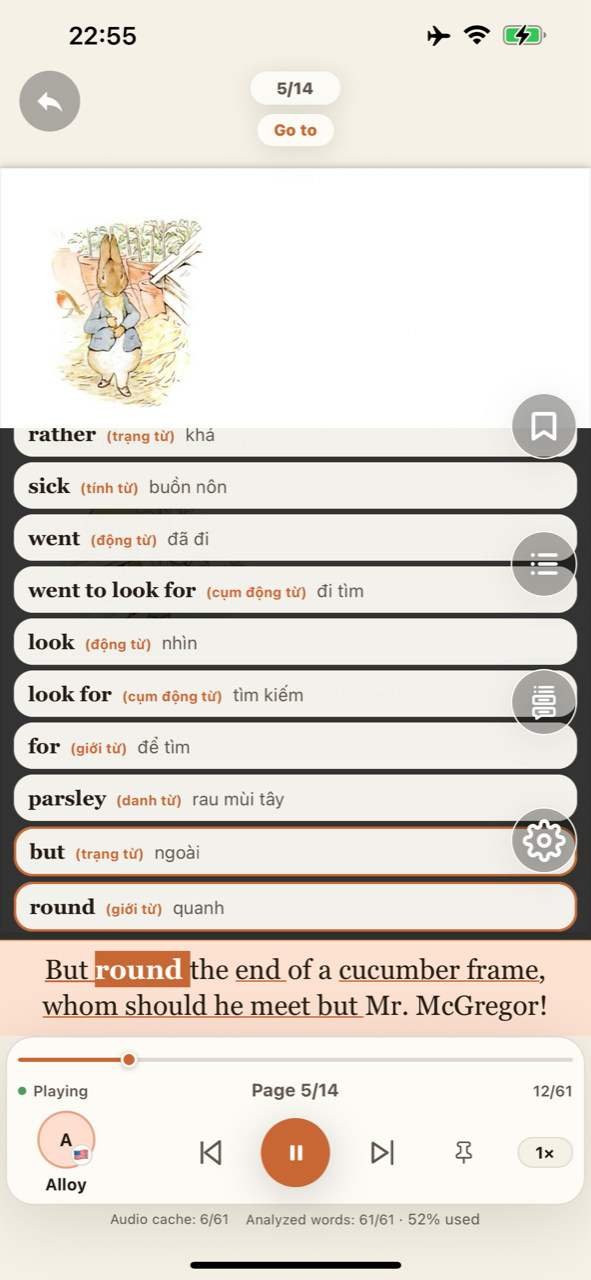
A word on its own tells only part of the story. Consider “take”: take a seat, take a photo, take your time. Knowing one translation does not tell you which expression fits the situation. Reading gives you that situation, along with the words around it. A good vocabulary habit keeps those pieces together.
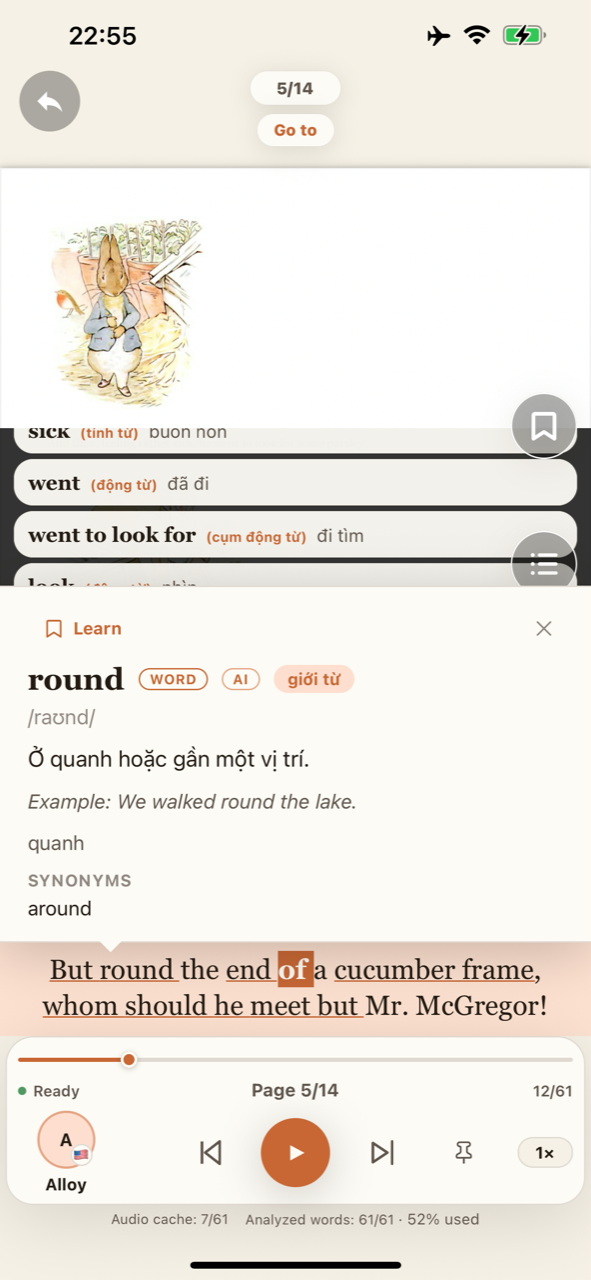
Look at the sentence before the definition
When you meet an unfamiliar word, read the sentence again and look at what comes before and after it. Is it describing a person, an action or a condition? Can you make a reasonable guess about the meaning? A guess is a starting point to check, not something you must force yourself to accept.
Then compare that guess with a dictionary or contextual explanation. In English Book Reader, the word popup connects the explanation to the current sentence. AI help can be useful, but it can also make mistakes; if the interpretation does not fit the passage, check another reference or the surrounding text.
Notice expressions, not only individual words
Useful language often arrives as a small group: “in a hurry,” “look forward to” or “make a decision.” Saving only one word may remove the part that makes the expression useful. Notice the preposition, the verb form and the nearby nouns that complete the pattern.
You do not have to label every pattern with a technical grammar term. Begin by keeping an example that you understand. Later, a sentence-level grammar explanation can help you see why the words are arranged that way.
Build a card that remembers the encounter
A useful card can include the expression, its meaning in this passage, the original sentence and a short pronunciation cue. Keep the explanation brief enough to review. Several unrelated meanings on one card can make it harder to remember what you intended to practice.
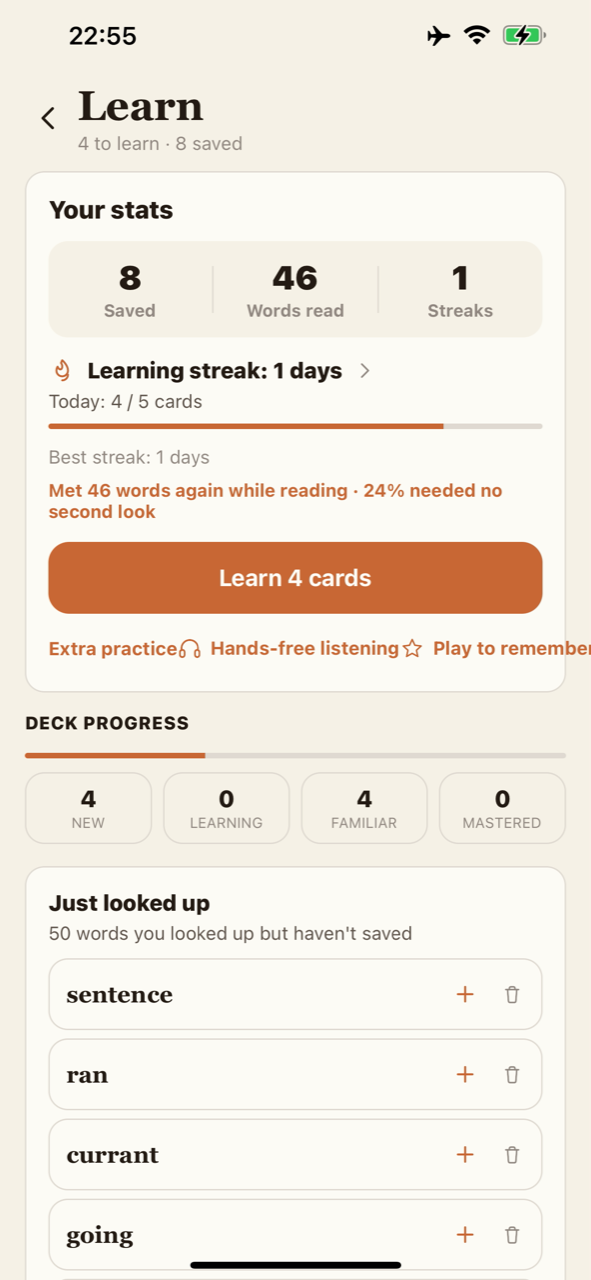
The app lets you save a word, expression or grammar point with its source sentence. That gives you a way to return to the encounter rather than reconstructing it from a detached translation. Choose cards you expect to meet or use again.
Write an example that belongs to you
After understanding the original example, try a new one about your own day. If your card is “in a hurry,” write about leaving for work or catching a bus. Keep the sentence simple. The goal is to test whether you can use the expression in a situation you recognize.
For a confusing phrase, compare your example with a reliable dictionary example. A grammatically possible sentence can still sound unusual, so look for the combinations people commonly use. AI explanations should support that checking, rather than replace it.
Return to the words through reading and review
Review a few saved cards, then keep reading. Meeting an expression in another passage gives you a chance to compare its use. Does it have the same meaning? Is the tone different? Those questions help you build a more flexible understanding than a single translation can offer.
Context is what turns a word you recognize into a word you can use, which is why the sentence is worth keeping beside the meaning. For a practical next step, read our article on reviewing saved vocabulary and explore the app’s contextual learning tools.
Bring the words into your reading.
Explore reading, on-device listening and AI English learning in one app.
Explore the app