
A little reading, every day
Free English Books in PDF & EPUB
Read and download free English ebooks, from A1 picture stories to unabridged classics. Browse by English level, topic or format and keep the PDF, EPUB or TXT file.
English only
EPUB & PDF downloads
No account needed
A reading journey
Series & Collections
Follow connected stories in order, or find a collection and choose where to begin.
For young readers
Kids Books
Discover stories selected for children, for reading together or exploring independently.
Saved on this browser only. Book availability may change. 3,949 books "Ethics — Part 1" by Benedictus de Spinoza is a philosophical treatise written between 1661 and 1675. This opening section explores the relationship between God and the universe through geometric proofs modeled after Euclid's method. Spinoza argues that God is identical with nature itself, not separate from creation. Through definitions, axioms, and propositions, he presents a radical vision where everything follows necessarily from divine nature, challenging traditional views about free will, divine purpose, and human understanding. "Ethics — Part 2" by Benedictus de Spinoza is the second part of a philosophical treatise written between 1661 and 1675. This section examines the nature and origin of the human mind and body, challenging Cartesian philosophy's fundamental assumptions. Spinoza argues that mind and body are one entity viewed differently, rejects free will, and distinguishes three kinds of knowledge—from unreliable sensory perception to intuitive understanding that relates particular things to God's nature. "Ethics — Part 4" by Benedictus de Spinoza is the fourth part of a philosophical treatise written between 1661 and 1675. Building on his radical ideas about God, nature, mind, and emotions, Spinoza addresses human bondage and the power of the passions. He examines how inadequate ideas and emotions enslave us, preventing us from achieving true freedom and virtue. Through geometric demonstrations, he explores the struggle between reason and passion, offering insights into human nature's constraints and possibilities for liberation. "Ethics — Part 5" by Benedictus de Spinoza is the fifth part of a philosophical treatise written between 1661 and 1675. Part 5 completes Spinoza's geometrically demonstrated system, examining human freedom and the path to blessedness. Building on his earlier propositions about God, mind, body, and emotions, Spinoza explores how understanding leads to power over passions and ultimately to intellectual love of God. This final section reveals his vision of human perfection and eternity. "Eugenie Grandet" by Honoré de Balzac is a novel published in 1834. Set in provincial France after the Revolution, it tells the story of a young woman trapped under the tyranny of her miserly father, Felix Grandet, whose obsession with wealth controls every aspect of their household. When her charming cousin Charles arrives bearing news of family tragedy, Eugenie's act of generosity ignites her father's rage and sets in motion a tale of forbidden love, financial manipulation, and the crushing weight of avarice in nineteenth-century French society. "Euthydemus" by Plato is a dialogue written around 384 BC. In this satirical work, Socrates recounts to his friend Crito a meeting with two Sophist brothers who claim philosophical superiority. Through a series of increasingly absurd logical tricks and fallacies, the brothers attempt to trap Socrates in verbal puzzles designed to be impossible to refute. Plato contrasts genuine Socratic education with what he presents as the deceptive methods of Sophist argumentation, exposing the emptiness behind their intellectual showmanship. "Euthyphro" by Plato is a philosophical dialogue written around 399 BC. Set outside an Athenian court, it follows Socrates as he awaits trial for impiety. He encounters Euthyphro, a confident prophet prosecuting his own father for murder. Socrates asks Euthyphro to define piety, sparking a rigorous examination that produces increasingly refined definitions—yet none prove satisfactory. Their discussion culminates in a famous dilemma about the gods' relationship to goodness, launching a debate that continues millennia later. "Evangeline: A Tale of Acadie" by Henry Wadsworth Longfellow is an epic poem published in 1847. It follows Evangeline Bellefontaine, an Acadian girl separated from her beloved Gabriel during the British expulsion of Acadians from Nova Scotia. The poem traces her years-long journey across America searching for him, coming heartbreakingly close without knowing. Written in dactylic hexameter imitating classical Greek and Latin verse, it became Longfellow's most famous work and powerfully shaped Acadian identity for generations. "Eve and David" by Honoré de Balzac is a novel written in the early 19th century, specifically as part of Balzac's larger work "Lost Illusions." This book follows the lives of David Sechard and his wife Eve, focusing on their struggles in the printing industry and the challenges they face due to the ambitions of David’s brother-in-law, Lucien, who has gone to Paris in pursuit of literary fame. As David works to invent a method for producing cheap paper to secure a better future for Eve and Lucien, the couple is pulled into a web of economic and social struggles. The opening of "Eve and David" introduces us to David Sechard, who aspires to create a fortune for his wife and brother-in-law. After marrying Eve, David grapples with economic hardship and mounting debts while obsessed with solving the pressing problem of cheap paper production. Meanwhile, Eve takes a proactive stance to support their household by learning the intricacies of the printing business. The couple's optimism clashes with external pressures from competing printers and the encroaching failures of their family. As Eve begins to understand their precarious financial situation, tension mounts with the return of Lucien’s disastrous news from Paris, setting the stage for a narrative steeped in ambition, sacrifice, betrayal, and the trials of marriage. "Evergreens" by Jerome K. Jerome is a reflective piece written in the early 20th century, described as a collection of essays or a philosophical commentary. The book centers around themes of steadfastness and resilience, drawing parallels between the characteristics of evergreen trees and the qualities of individuals who exhibit strength and constancy in life's challenges. Through a blend of whimsical anecdotes and serious reflections, Jerome explores the importance of valuing enduring relationships over fleeting superficial charms. In "Evergreens," Jerome presents a thought-provoking narrative on the nature of companionship and the virtues that truly matter in both friendship and romantic relationships. He contrasts the short-lived beauty of seasonal flowers with the enduring presence of evergreens, emphasizing how true strength lies in reliability and unchanging support throughout the seasons of life. Through humorous observations, such as those involving a bulldog and personal anecdotes, he illustrates the often-overlooked characters who, despite their unremarkable façades, offer profound loyalty and steadfastness when faced with life's adversities. Ultimately, Jerome urges readers to appreciate those who might seem dull or ordinary but are, in reality, vital pillars in the journey of life. Samir is on a mission to save all the water he can. His mission takes him to several houses where he learns new and exciting ways to make every drop count! Can he, with the help of his Mina Chachi, make a difference? PDF · Fixed page layoutIllustrations: not assessed Categories: Engineering & Technology Non-fiction Personal Development Science & Nature Collection: Editor’s Picks Readers: Kids Suggested age: Not assessed Adil has a full hour to get ready and walk to school. But he is late every day! Where is he losing time? His friend Paro decides to help him account for every minute of the hour. PDF · Fixed page layoutIllustrations: not assessed Categories: Engineering & Technology Family & Friends Mathematics Science & Nature Collection: Editor’s Picks Readers: Kids Suggested age: Not assessed Suggested age, readers, English difficulty and US school grade are separate labels. Age groups are guidance based on source information or editorial review; unreviewed books are “Not assessed”. A US grade is assigned only with source information or a documented assessment; otherwise it is “Not assessed”. Levels use A1–C2 to indicate reading difficulty. StoryWeaver levels 1/2/3/4 use our approximate A1/A2/B1/B2 guide, labelled “estimated”; this is not an official equivalence. A book-specific assessment takes priority. Other unassessed books are labelled “Not assessed”. Source StoryWeaver levels are retained separately. Classics retain their original English.
Want to read
Ethics — Part 1
Ethics — Part 2
Ethics — Part 4
Ethics — Part 5
Eugenie Grandet
Euthydemus
Euthyphro
Evangeline: A Tale of Acadie
Eve and David
Evergreens
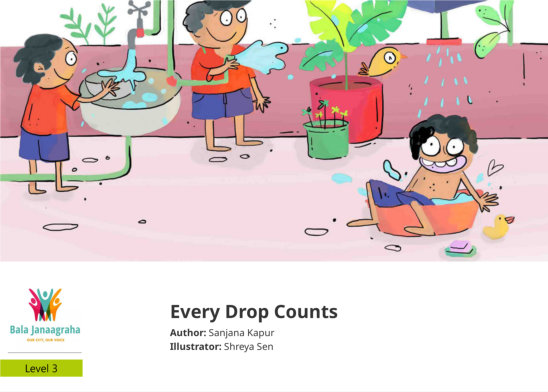
Every Drop Counts
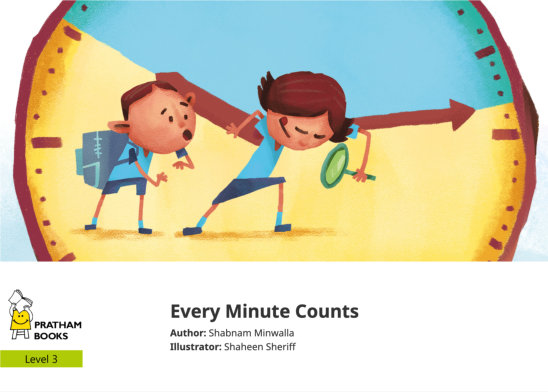
Every Minute Counts
From a free ebook to your next reading habit.
These illustrated stories were created for children. Their short chapters and visual clues can also help English learners find an approachable place to start.
- Choose a story and download its PDF.
- Read it in your usual PDF reader, or save it to Files on your phone.
- In English Book Reader AI & Learn, open the import menu, choose Choose a PDF and select the saved file. You can then read, listen and explore English in context.
PDF downloads are free. App features and paid options are separate. Explore the app.
Shared with permission, credited with care.
This library includes openly licensed StoryWeaver stories and reviewed public-domain classics. Each book page explains its source, credits and reuse terms. Public-domain status depends on the country and exact edition. CC BY books require appropriate credit, the license link and an indication of changes.
Author, illustrator, publisher and original credits appear on each book page and inside the PDF. PDF formatting or safety changes are described on the book page. These books remain governed by their own license; app subscription terms do not restrict those rights. English Book Reader is an independent collection, with no endorsement by the original creators or StoryWeaver implied.
Have a question about a book or its credits? Contact us.